EVA Air upholds the principle of ethical management, a sound corporate governance structure, rigorous internal control system, and excellent risk management. While strengthening the company’s operating performance, EVA Air also protects the interests of shareholders and other stakeholders. As for the 12th “Corporate Governance Evaluation of Listed Companies”, the Company was ranked in the range of 6% to 20% of all listed companies, representing EVA Air’s good performance of Corporate Governance.
Corporate Governance Framework
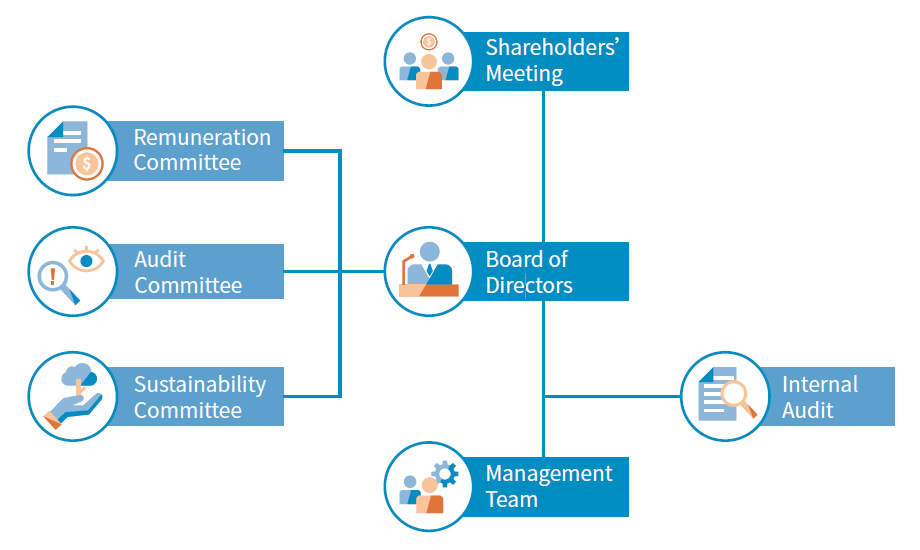
EVA Air’s Directors are elected by shareholders’ meeting through a candidate nomination system in accordance with the Company’s Articles of Incorporation. The Board of Directors consists of nine Directors, including three independent directors (one of whom serves as an Independent Director Undertaking Public Welfare). All Directors serve a three-year term. The current Board was elected at the Annual General Shareholders’ Meeting on May 29, 2026. As of May 31, 2026, the average continuous tenure of all Directors was 2.6 years, and none of the Independent Directors had served more than nine consecutive years.
| Remuneration Committee |
Audit Committee |
Sustainability Committee |
| The Committee, which consists of entire independent directors, assists in formulating and periodically reviewing the performance evaluation and remuneration policies, systems, standards and structures for the directors and managers, and also periodically evaluates and determines the remuneration of the directors and managers. Three meetings were convened in the year 2025, and the average attendance rate of all Remuneration Committee members is 100%. |
EVA Air established the Audit Committee on June 26, 2017, which consists of entirely independent directors, with at least one with accounting or finance expertise. The Committee helps to supervise the fair presentation of the Company’s financial reports; appointment of accountants, as well as the independence and performance of the accountants; the effective implementation of the Company’s internal control system; and risk management related to all these tasks. Five meetings were convened in the year 2025, and the average attendance rate of all Audit Committee members is 100%.
|
To fulfill the Company’s corporate social responsibility and achieve sustainable business goals, EVA Air established the Sustainability Committee on December 23, 2022. The committee is composed of five members and the majority of its members are independent directors. The Sustainability Committee is responsible for reviewing and approving sustainability-related (including risk management of threats and opportunities) policies, procedures, structures, objectives, and management guidelines. It also reviews the annual sustainability work plan and oversees and monitors its implementation progress and results to ensure effective execution of the Company’s corporate governance framework and alignment with its sustainable development objectives. Four meetings were convened in the year 2025, and the average attendance rate of all Sustainability Committee members is 100%.
|
Structure and Operation of the Board of Directors
The Chairman of EVA Air is primarily responsible for overseeing the management team and ensuring that business operations are conducted in accordance with the Company’s management philosophy. The President is responsible for leading the management team and ensuring that EVA Air’s overall operations are carried out in accordance with the directions of the Board of Directors. To maintain a clear separation of responsibilities and avoid potential conflicts of interest, the Chairman does not concurrently serve as President.
The Board of Directors convenes at least once every quarter and may be called at any time in the event of urgent circumstances. In accordance with the Company Act, the Securities and Exchange Act, the Company’s Articles of Incorporation, and other applicable regulations, the Board exercises its authority and is responsible for resolving matters related to the Company’s operations. To prevent conflicts of interest, EVA Air complies with its Corporate Governance Best Practice Principles and Rules of Procedure for Board of Directors Meetings. Directors who have a personal interest, or represent a juristic person with an interest, in any matter submitted to the Board are required to disclose the material aspects of such interest at the relevant Board meeting. Where such interest may be detrimental to EVA Air’s interests, the Director shall neither participate in discussions or vote on the matter and shall recuse himself or herself from the discussion and voting, nor exercise voting rights on behalf of another Director.
In accordance with Article 21 of the Company’s Corporate Governance Best Practice Principles, Directors should not concurrently serve as directors of more than five TWSE- or TPEx-listed companies. Pursuant to Article 24 of the same Principles, Independent Directors should not concurrently serve as directors (including independent directors) of more than five TWSE- or TPEx-listed companies, nor serve as independent directors of more than four public companies simultaneously.
In 2025, no violations were identified through cases received via the Integrity Management Consultation and Whistleblowing Mailbox or the Corporate Sustainability Mailbox. Updates on the implementation of integrity management initiatives and stakeholder communication activities were separately reported to the Board of Directors by the responsible departments.
Remuneration for Directors and Managers
Pursuant to Article 26 of the Company’s Articles of Incorporation, when the Company records a profit for the year, employee remuneration shall be no less than 1% of such profit. Management remuneration is governed by the Company’s Payment Regulation of Management Compensation and consists of fixed and variable compensation. Fixed compensation includes salary and allowances, which are determined based on the Company’s organizational structure, business functions, job responsibilities, and internal and external market considerations. Variable compensation includes year-end bonuses and employee remuneration.
Year-end bonuses for management personnel are determined based on performance evaluations covering factors such as job performance, leadership, adaptability, innovation, professional knowledge and experience, planning capability, and cost management awareness and other relevant performance factors. In addition to performance-based assessments, year-end bonuses for senior management are linked to sustainability performance through the ESG Performance and Senior Executive Compensation Linkage Policy. Relevant in)dicators cover environmental, social, and governance (ESG) performance as well as operational performance metrics, including financial performance (such as, but not limited to, Return on Equity (ROE)), customer satisfaction, and flight safety. This mechanism is designed to encourage and incentivize senior management to actively participate in and advance the Company’s ESG objectives.
Significant achievements by senior management related to material topics in 2025 are presented in the table below. Bonus amounts are reviewed by the Remuneration Committee and approved by the Board of Directors. The Company has not established any clawback mechanism for directors’ or management’s remuneration after payment. Further information on remuneration , please refer to the
Charter of Remuneration Committee.
Diversification of Directors
The members of the Board each bring expertise from distinct professional fields, including business management, transportation management, engineering management, finance and accounting, financial management, information technology, environmental protection, sustainability management, risk management, telecommunications, and law. The composition of the Board is also determined with consideration given to diversity, including gender, age, nationality, race, and culture. Independent directors possess a certain level of understanding of risk management through their education and professional experience. Their extensive expertise enables them to provide professional opinions and adopt a multi-dimensional thinking approach, which assists the Board of Directors in making decisions that are most beneficial to the Company’s operations.
Every year, EVA Air holds training sessions for directors based on the characteristics of the aviation industry and the needs of directors, and also provides directors with information on training courses and forums organized by competent authorities and professional training institutions. Directors actively participate in both internal and external training programs covering topics such as risk management, corporate governance, corporate sustainability, information security, and integrity management. In 2025, each director completed the required training in accordance with the Directions for the Implementation of Continuing Education for Directors of TWSE and TPEx Listed Companies, with an average training duration of approximately 7.22 hours. For detailed information on directors’ continuing education, please refer to
the Corporate Governance section of EVA Air’s website or the
Market Observation Post System (MOPS).
For information of the diversity status on the Company's board members, please refer to the
Implementation of the diversity policy on board members of the Corporate Governance section on EVA Air's website.
Nomination and Election of Director
According to the Company's Articles of Incorporation, EVA Air elects 9 directors (including 3 independent directors) for a term of 3 years. The election process follows the candidate nomination system as stipulated in Article 192-1 of the Company Act and the provisions of the Company's Articles of Incorporation. Shareholders holding 1% or more of the Company's issued shares may submit a written list of director candidates during the nomination period. Shareholders shall elect directors from the list of candidates announced by the Company.
According to Article 20 of EVA Air’s Corporate Governance Best Practice Principles, the composition of the Board of Directors takes into consideration diversity, independence, and the professional competencies required for the performance of directors’ duties.
Please refer to
the Corporate Governance section on EVA Air's website for information on the election of the current Board of Directors for the term from May 29, 2026, to May 28, 2029.
Performance Evaluation of the Board of Directors
To enhance the functions of the Company’s Board of Directors in accordance with the “Regulations Governing Board Performance Evaluations” formulated by the Board of Directors, the Board of Directors shall carry out an internal board performance evaluation at least once a year. The evaluation indexes include the level of participation in company operations, improvement of the Board of Directors' decision-making quality, composition and structure of the Board of Directors, director appointment and continuing education, internal controls, and implementation and promotion of sustainable practices (ESG). In addition, an external board performance evaluation may be conducted every three years. In 2025, self-evaluation of performance of the Board, self-evaluation of performance of Board Members, self-evaluation of performance of the functional committees (Audit Committee, Remuneration Committee, and Sustainability Committee) were conducted. The results of these self-evaluation are as follows. The recommended improvement plans are all categorized as ongoing efforts to strengthen corporate governance and further details can be found in
the Corporate Governance section on EVA Air’s website.
| |
Self-evaluation of Performance of the Board |
Self-evaluation of Performance of Board Members |
Self-evaluation of Performance of the Remuneration Committee |
Self-evaluation of Performance of the Audit Committee |
Self-evaluation of Performance of the Sustainability Committee |
| Overall Average Score (5 points for full marks) |
4.98 |
4.99 |
5 |
5 |
4.99 |
| Results |
Excellent |
Excellent |
Excellent |
Excellent |
Excellent |