
Copyright © EVA Airways. All rights reserved.



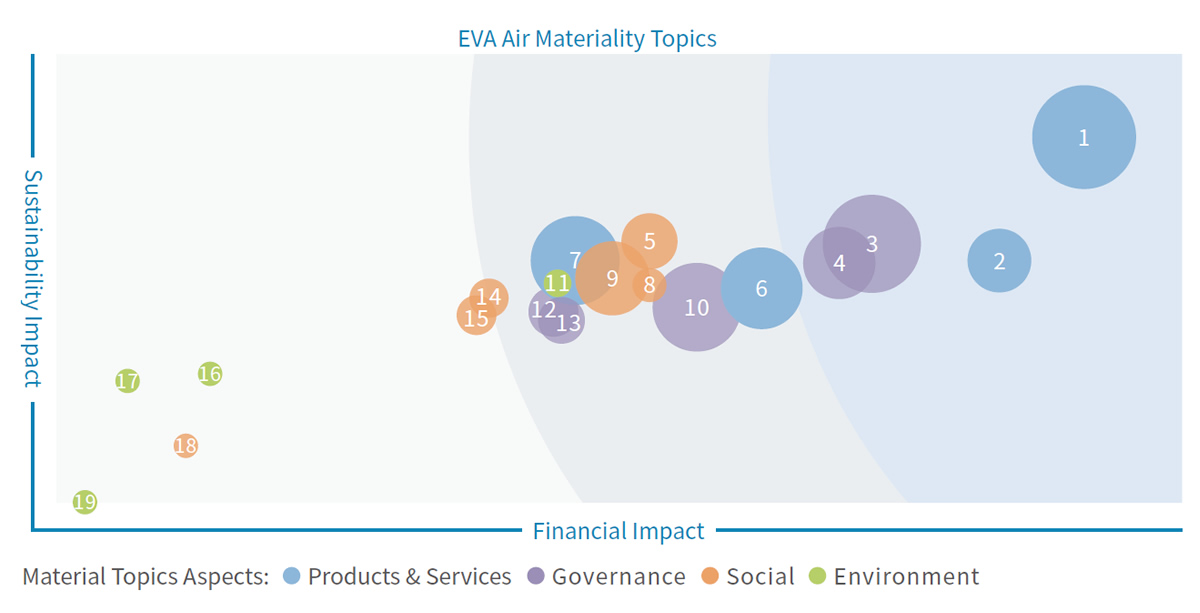
EVA Air follows the latest GRI Standards, international sustainability trends, and the development of benchmark airlines in collecting professional insights from the 9 action teams of the Corporate Sustainability Committee regarding the positive and negative impacts of sustainability topics on the economy, environment, and people (including human rights). We also consider the levels of concern from 7 categories of external stakeholders on sustainability issues. Additionally, we adopt the double materiality principle proposed by the European Union, considering the significant financial and non-financial impacts of sustainability topics on both “EVA Air” and the “external aspects (economy, environment, and people)”. Through identification and assessment, we have prioritized 13 material topics for EVA Air in 2025. Going forward, EVA Air will conduct this process annually, aligning with the principles of sustainability context, materiality, completeness, and stakeholder inclusiveness. These material topics will be integrated into EVA’s Enterprise Risk Management (ERM) to effectively and accurately manage corporate risks and sustainability strategies.
| Stakeholder | Importance to EVA Air | Issues of Concerns | Our Response | ||
|---|---|---|---|---|---|
| Communication Channel and Frequency | Communication Content and Results | Performance | |||
| Customers | Customers are the Company's primary source of revenue. Maintaining customers' trust in and satisfaction with the EVA Air brand enhances customer loyalty and contributes to sustainable business growth. |
• Flight Safety • In-flight Catering Management • Information Security and Privacy Protection |
Official website Traveling Experience Feedback, phone calls, written feedback, email, branch offices, Chief Purser flight report on demand or as needed. |
1. Flight safety is our core value and our commitment to customers. EVA Air formulated “EVA Corporate Safety Policy.” The customers can know more about our efforts and actions through the public platform. 2. Airline catering food safety management complies with the hygiene standards assessment form for airline catering set by IFSA, as well as HACCP regulations. In addition, we ask our caterers to comply with related regulations, and the quarterly defect-free meal rate was calculated based on meal irregularity cases reflected by our passengers. 3. While providing customer-related services, we are committed to ensuring the protection of customer’s data, privacy and interests. Information on personal data collection, usage, privacy protection, and security statements are clearly stated in the “Privacy Policy” and “Cookies” on EVA Air’s website. |
• Net Promoter Score (NPS): 72.82 • Overall Cargo Satisfaction: 4.52 • Awarded the SKYTRAX 5-Star Airline Certification for ten consecutive years and received the World's Best Economy Class Airline Catering and World's Cleanest Airline awards in 2025. • Recognized by the Airline Passenger Experience Association (APEX) with the Five Star Global Airline and Best Seat Comfort awards. |
| Employees | Employees are the Company's most valuable asset and are essential to its operations. EVA Air continues to strengthen employee development and workplace safety to create shared value and support sustainable business development. |
• Flight Safety • Operational Performance • Information Security and Privacy Protection |
1. Quarterly Labor-management Communication Meetings 2. Multiple unions communication meetings on regular basis 3. Cabin crew seminars held one to two times per month 4. Quarterly committee meeting (Corporate Sustainability, Occupational Safety and Health, Employee Welfare, etc.) 5. Monthly departmental meeting 6. Investigation report on occupational accident as needed 7. Complaints hotline and mailbox on demand 8. Occasional reporting of occupational safety and health issues via email |
1. Integrate the safety goal of "zero accidents" into every employee's mindset and daily work. All employees are required to complete the Aviation Safety Basic Training course to reinforce the Company's safety culture. 2. Disclose financial condition on relevant platforms such as official website; and convey the company's operating status, direction and major policies through regular meetings to achieve goals jointly, drive revenue, and ensure sustainable development. 3. Conduct regular social engineering drills and educational training, periodically disseminate information security news and updates on the Company website, hold annual online education and training course for all employees. Additionally, establish reporting procedures for information security events, ensuring that employees promptly follow these procedures when they become aware of any such events. |
• Introduced the ISO 45001 and TOSHMS standards. • Monthly Occupational Safety and Health Promotion Materials: 12 items • Safety and Health Information Sharing: 10 articles • Total number of communication meetings with various unions: 29 • Department meetings: Monthly |
| Government/NGOs | As the Company's competent authorities, they have a certain level of influence and supervisory responsibility over the overall operational policies. |
• Climate Change Adaptation and Mitigation • Green Operations Management • Green Travel Services |
Meeting, Official correspondence from government agencies, phone calls, audit, related business websites, participation in initiatives and seminars on demand or as needed |
1. With reference to the decarbonization strategies and targets established by the International Air Transport Association (IATA), EVA Air implements various aircraft decarbonization initiatives. 2. EVA Air is committed to achieving net-zero carbon emissions by 2050. The Company has established short-, medium-, and long-term decarbonization strategies and joined the Science Based Targets initiative (SBTi). 3. EVA Air promotes the reduction of single-use plastics used in onboard services by replacing them with reusable, biodegradable, or recyclable alternatives. We also collaborate with suppliers to develop more sustainable service items and products while reducing the use of packaging materials. |
• Participate in meeting and project held by international organization. • Result of Corporate Governance Evaluation: ranked within the range of 6% to 20% among all listed companies. |
| Travel Agencies | As the Company's key business partners, travel agencies are responsible for selling flight tickets and providing reservation, ticketing, and other travel-related services, jointly contributing to revenue generation. |
• Flight Safety • Information Security and Privacy Protection • In-flight Catering Management |
Phone call, visit in person, travel agency conference, letter, E-mail on demand or as needed |
1. Flight safety is EVA Air's core value and commitment to passengers. EVA Air communicates its safety initiatives and performance through public communication channels to keep stakeholders informed of its ongoing efforts. 2. EVA Air complies with applicable personal data protection regulations in the regions where it operates when collecting, processing, and using personal information. The Company has established an Information Security Policy to effectively manage network, IT system, and data security, thereby mitigating the risks of cyberattacks and data breaches. 3. In-flight catering food safety is managed in accordance with the hygiene assessment criteria established by the International Flight Services Association (IFSA) and the HACCP system. EVA Air requires all airline catering providers to comply with these requirements, including supplier management, personnel hygiene, employee training, pest control, cleaning, and environmental hygiene. |
• Taiwan passenger revenue: TWD 54.4billion • Optimize B2B system to improve efficiency. Also, to align with the Company’s ESG goals, complete automatic check-in functions for group passengers; continue improving online check-in rates and adoption of electronic boarding passes. |
| Media Reporters/External consultants/scholars and experts | As the Company’s important business partners, their strong understanding of the industry and academia is beneficial for EVA Air to optimize organizational strategies and increase exposure. |
• Flight Safety • In-flight Catering Management • Occupational Safety and Health Management |
Telephone counseling, E-mail, press conference as needed |
1. Update information at any time on public platforms such as the official website, CSR website, Market Observation Post System, and social media. 2. In response to the questions raised by the media, the internally information is collected, organized and publicly announced by the Public Relations Div. to ensure the authenticity of reports’ content and avoid the reputation damage and financial loss of the company due to the spread of false information |
• Announced 54 Mandarin and English press releases. • Over 700 global advertising exposures |
| Shareholders and Investors | They play a key role in corporate governance and operations, holding company shares, having the right to attend shareholders' meetings, and possessing voting rights. This will benefit EVA Air to provide market value and long-term competitiveness. |
• Flight Safety • Operational Performance • Information Security and Privacy Protection |
1. Shareholders’ meeting once a year 2. Investor conference at least once a year 3. Official website on demand 4. Shareholder hotline & mailbox on demand 5. Important financial and business information on MOPS (as per the regulations of competent authorities) |
1. “Safety, Service, and Sustainability” are the core operational value of EVA Air. We continually strengthen safety on flight operation and ground operation through operating safety management framework. 2. Regularly report on operational status and views on future industry prospects; convey business philosophy and corporate value; summarize major business project on annual report; provide important financial and business information for investors’ reference. 3. EVA Air has established the “Risk Management Policy and Procedures”, carried out risk identification, assessment, management, and disclosure for the risks that may be faced during business operation in terms of the economy (including corporate governance), environment, society, and other aspects in accordance with the principle of materiality, and report the operational status to the Board of Directors on a regular basis. 4. EVA Air has been committed to establishing information security management system (ISMS) and enforcing compliance with rules and regulations. We set up a dedicated department to manage and monitor ISMS and personal information protection, and set up "Information Security and Privacy Protection Committee" to implement the norms in all business areas. The CISO is responsible for the promotion of information security policies and report to the Board of Directors on a regular basis. |
• Shareholders’ meeting in May 2025. • Investor conference in May 2025. • Issued 30 bilingual Material Information Announcements and 16 other announcements. |
| Suppliers | As the Company's key business partners, suppliers provide the products and services required for EVA Air's operations, helping maintain service quality, brand reputation, and corporate image. |
• Information Security and Privacy Protection • Business Integrity and Ethics • Flight Safety |
1. Annual Supplier Conference 2. Telephone, email, business visits, and on-site visits (as needed) |
1. EVA Air formulated the Supplier Code of Conduct (SCoC), requiring suppliers to follow relevant norms on confidentiality obligations and information security. 2. In order to understand and grasp the sustainability status of the overall supply chain, we have formulated the SAQ according to the procurement procedure manual. Based on the SAQ results, potentially high risk suppliers and critical suppliers are audited and counseled to ensure that the risks can be effectively controlled and reduced. 3. We formulated information security policies, and required that all business partners and their employees follow both the policies and their related management mechanisms. We have also published information security and privacy protection policies on the corporate website, as a demonstration of the Company’s pledge to ensure information security and protect personal data. 4. We value opinions and feedback from customers, suppliers, and other stakeholders, and provide diverse channels by which they can submit feedback. We embrace innovation and pay close attention to every detail, always striving to offer a better, wider array of aviation services. |
• Held in-person’s supplier conference in September 2025. • The communication rate of Supplier Code of Conduct: Tier 1 suppliers: 100% Critical suppliers: 100% • Response rate of SAQ: Tier 1 suppliers: 100% Critical suppliers: 100% |